

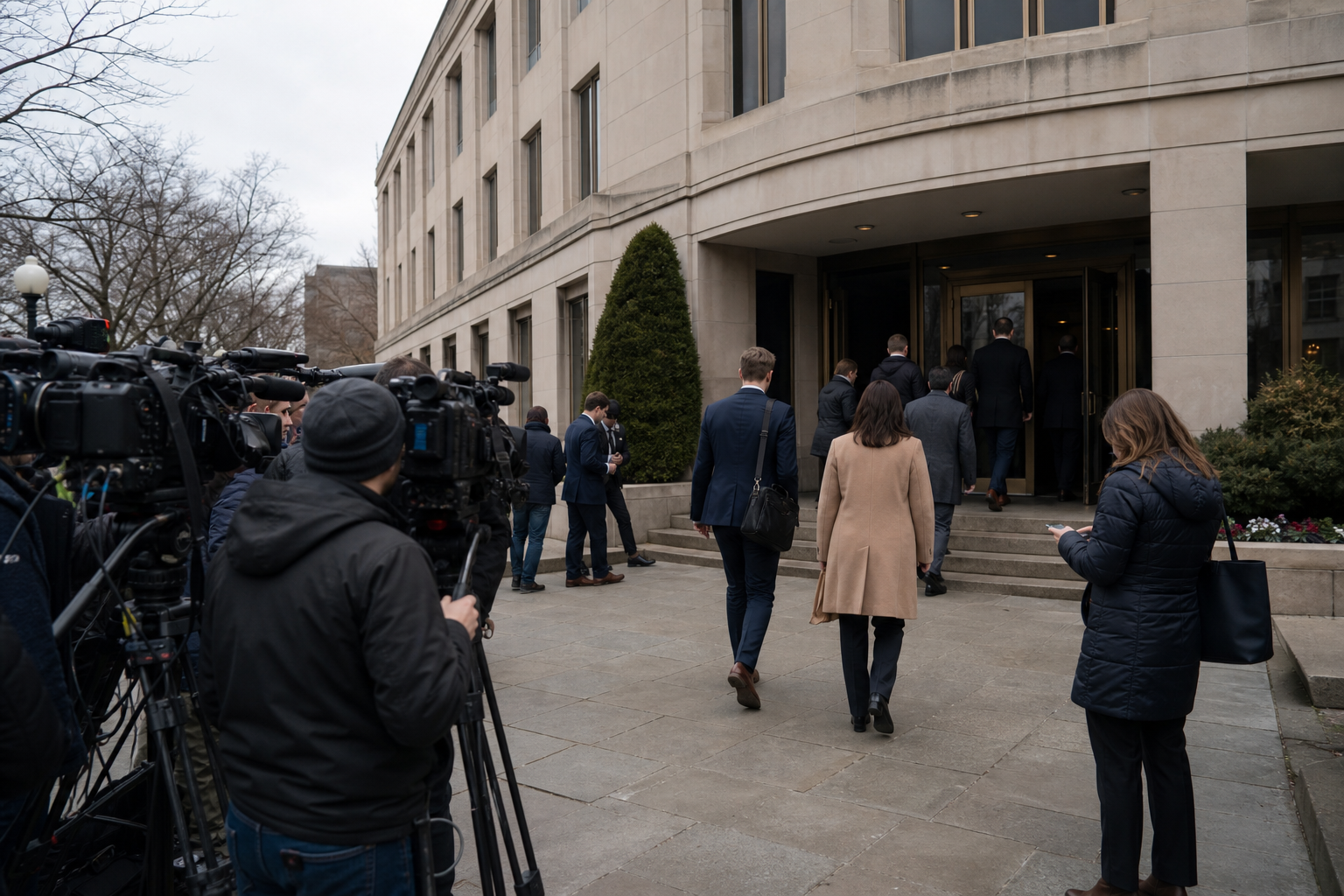
The Democratic National Committee is facing an uncomfortable truth that Washington institutions usually try to postpone as long as possible: management failures do not stay internal for very long. When a national party confronts allegations of leadership misconduct while also wrestling with serious financial pressure, the problem is no longer merely operational. It becomes political, reputational, and strategic all at once.
That matters because party committees are not ornamental bodies. They are the machinery that turns activist energy into voter turnout, campaign dollars into field operations, and national messaging into actual electoral advantage. When that machinery appears unstable, candidates notice, donors notice, and voters eventually do too.
For Republicans, there is an obvious temptation to treat Democratic infighting as simple political entertainment. It is certainly politically useful when the opposition looks disorganized. But the larger lesson is more serious than that. A party that asks the country to trust its stewardship of major public institutions ought to be able to demonstrate basic stewardship of its own.
Why financial strain matters
Debt inside a national party committee is not, by itself, proof of collapse. Political committees routinely raise and spend aggressively, especially in presidential cycles. They borrow against future fundraising, invest heavily in turnout operations, and sometimes absorb short-term deficits in hopes of long-term gains. That is not unusual.
What is unusual is when financial stress arrives alongside public questions about leadership conduct, internal discipline, and strategic coherence. At that point, money stops being a bookkeeping issue and starts becoming a measure of confidence. Donors want to know whether their dollars are advancing a plan or merely patching over dysfunction. Down-ballot candidates want to know whether the national apparatus can support them when the campaign calendar tightens. Staff want to know whether decisions are being made competently and ethically.
In politics, financial weakness often compounds itself. Big donors become cautious. Smaller donors grow fatigued. Vendors demand clearer terms. Rival factions inside the party use budget strain to argue for a shake-up. The result is a feedback loop: less confidence produces less money, and less money produces still less confidence.
Misconduct allegations are not a side issue
Leadership misconduct allegations, whatever their precise facts in any given case, are not a public-relations inconvenience to be filed away behind campaign talking points. They go to the heart of institutional legitimacy. A national committee depends on trust from activists, employees, candidates, allied groups, and contributors. If people inside the organization believe standards are unevenly applied, or that power protects insiders from accountability, the damage extends well beyond one news cycle.
Democrats have spent years arguing that norms, ethics, and institutional integrity are central political values. Fair enough. But those claims invite scrutiny at home as well as abroad. If party leaders ask voters to see them as responsible custodians of democratic institutions, then the same voters are entitled to expect transparency, discipline, and credible internal accountability.
This is not a uniquely Democratic problem. Both parties have, at various times, tolerated weak management, protected favored insiders, and confused messaging with governance. But when Democrats campaign explicitly on competence and moral seriousness, visible disorder inside the DNC hits harder than a routine factional spat. It suggests a gap between the party's message and its internal practice.
The strategic problem for Democrats
The timing is especially difficult. National parties need clear direction during periods when the political map is shifting, media fragmentation is accelerating, and voter coalitions are becoming less stable. Democrats are already managing tensions between progressives and moderates, between the activist class and working-class voters, and between a national message crafted for social media and the practical concerns of families looking at prices, wages, schools, and public safety.
An internally weakened committee is poorly positioned to referee those disputes. Instead of serving as a stable coordinating body, it risks becoming another arena for them. That can have practical consequences in candidate recruitment, field spending, legal compliance, debate over issue priorities, and the basic work of coalition maintenance.
It also creates a familiar Washington temptation: to solve a credibility problem with branding. New slogans, new consultants, and a fresh rollout can briefly distract from structural weaknesses. But if the underlying problem is poor governance, cosmetic adjustments will not do much. Voters are often less ideological than political professionals imagine. They respond to signs of seriousness, steadiness, and competence. A party that looks adrift does not inspire confidence, even among many who agree with its stated goals.
What conservatives should notice
There is a broader point here for conservatives who care about institutional accountability. Political organizations are often small-scale versions of governing philosophies. If a party struggles with financial discipline, managerial clarity, and internal accountability, it is reasonable to ask how that mindset might translate into public administration.
That does not mean every deficit on a party balance sheet predicts a fiscal disaster in government. Politics is not that neat. But habits matter. So do incentives. An institution accustomed to papering over tradeoffs, centralizing decision-making, and avoiding clear lines of responsibility will tend to carry those habits into office. Washington already has far too much of that culture.
Conservatives should resist the lazy version of this argument, which is merely to say that Democrats are hypocrites and leave it there. The stronger argument is that accountability must be more than a campaign theme. It requires mechanisms, transparency, consequences, and leadership capable of accepting limits. Those are not partisan values. They are constitutional ones.
What comes next
The immediate question is whether Democratic leaders can restore confidence before financial and organizational weaknesses harden into a narrative of drift. That will require more than assurances. It will likely require visible corrective action, tighter governance, and a credible explanation to donors and activists about how the committee intends to regain footing.
In practical terms, that means answering a few basic questions. Are internal standards being enforced fairly? Is there a realistic financial plan? Is leadership aligned on priorities? Can the committee persuade skeptical stakeholders that money is being spent effectively and responsibly? Those are mundane questions, perhaps, but politics is often won or lost on the mundane. Competence is not glamorous. It is simply indispensable.
For the country, the episode is another reminder that institutions do not become trustworthy by invoking trustworthiness. They become trustworthy by behaving in ways that earn it. That is true of federal agencies, congressional leadership, and party committees alike.
If Democrats want to argue that they are the party of responsible governance, they will need to show that responsible governance begins at home. Until then, every report of internal turmoil and financial distress will raise the same uncomfortable question: if this is how the organization manages itself, why should voters assume it can manage anything larger?


